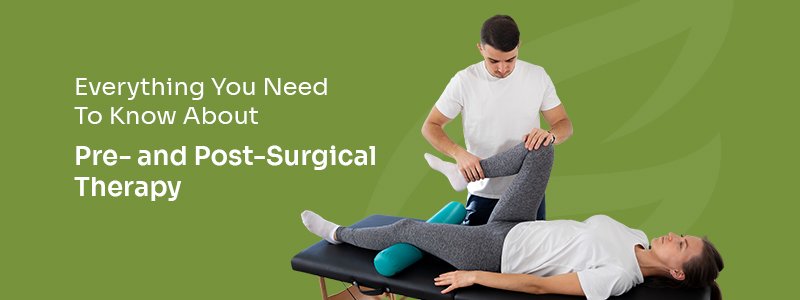
Everything You Need To Know About Pre- and Post-Surgical Therapy
Any kind of surgery, big or small, is quite daunting. The choice of going through with it, the build-up to the day, and the subsequent prolonged surgical rehabilitation period. Your body requires time, nurturing, and attention to recover, no matter the extent of the operation, be it joint replacement, spine surgery, or even a minor orthopaedic surgery.
However, most people disregard the effect pre- and post-surgery therapy has on their surgical rehabilitation path. While regaining mobility is absolutely essential, it is also equally important to gain strength, make sure that you don’t injure yourself again, and focus on restoring your flexibility and range of motion.
Getting surgery is tiring enough; your recovery shouldn’t be the same. Stress and exhaustion can be reduced in several ways, which will lead to quicker recovery and prevent future complications. Pre-surgical and post-surgical treatments get down to the nitty-gritty of your injury and place you in line for a quick and safe recovery.
What Is Pre-Surgical Therapy?
Pre-surgical therapy is an individualized physical therapy that is meant to prepare your body to undergo the strains of a surgery. It focuses on:
- Building strength in the muscles surrounding the surgical area.
- Enhancing your movement.
- Training and understanding safe movement techniques immediately after surgery.
- Lessening inflammation and rigidity.
- Preparation for the recovery process mentally.
Consider it to be preparation for the body to be in its absolute best condition before getting under an operating table, giving you the best chances for a quick and easy recovery path.
What Is Post-Surgical Therapy?
Once the surgical operation is done, it is by physiotherapy that you regain your strength, get back your movement, and protect yourself from problems like stiffening or the atrophy of muscles. Any post-surgical physiotherapy in the facility of Saburi is, without a doubt, at your own speed, pleasant, and specially made for both your operation and your way of life. It might include:
- Light exercises to regain mobility.
- Balance and gait training
- Manual therapy to decrease stiffness.
- Pain management techniques
- Home-based exercises for posture and movement.
This form of surgical therapy not only accelerates the healing process but also reduces your chances of re-injury or chronic complications.
Both pre- and post-surgery therapy play an important role…
Most consider physiotherapy only post-surgery and once their muscles get stiff and achy, but if you take anything from this, it is that pre- and post-surgery therapy are extremely important for smooth recovery and are best used in conjunction. Combinedly, therapy before surgery and therapy after surgery are means by which one can:
- Cut down the time of recovery.
- Have good control over pain and swelling that happens after the operation.
- Lower the probability of complications.
- Avoid the injury again.
- Facilitate daily movement.
What are the conditions or surgeries that are good for therapy?
Pre- and post-surgical therapy may assist recovery following most forms of surgery, including:
- Complete knee or hip replacement.
- Spinal surgeries
- Repair of the ligaments or tendons
- Fractures.
- General orthopaedic processes.
A well-developed course of surgical therapy can be used even for minor surgeries in order to prevent problems and complications in the future.
What to Expect at Saburi,
Our practice at Saburi is based on empathy, patience, and effective communication.
We lead you through in the following way:
- Pre-Surgery
We thoroughly examine your current condition, find your weak areas and train you to be in your best shape to go through the perils of a surgery.
- Post Surgery
We start with soft and guided therapy, which aids healing. Then we advance your program step by step as you become stronger and more mobile.
No rush. No pressure. A plan developed with care for consistency and the aim to help you get back to your best health.
You are in good hands…
We understand how much strength, time and faith a surgery demands of you. At Saburi, we aim to provide the absolute best care with physiotherapists you trust, so this process becomes a little less daunting, on both body and mind.
From the first initial step right through to the big stride, we are here to ensure you do not just recover, but you fully restore your confidence and strength in every way, with professional and trained hands.
Frequently Asked Questions
Pre-surgical therapy is geared towards preparing your joints and muscles, making the surgical procedure comfortable for your body. After surgery, therapy helps your body heal by helping you avoid complications and enabling you to move freely and become strong safely.
Physiotherapy eases inflammation, returns mobility, and gradually strengthens to ensure freedom of movement and prevent re-injuries.
It is not necessarily mandatory, but to a large extent it is highly recommended. This is particularly during surgery involving the joints, bones, tendons and the spinal area. In the case of less severe surgeries, healing is comparatively quicker with the help of a skilled therapist.
Depending on the type of surgery, the exercises vary; however, in most cases, the following exercises are involved:
- Close range of motion activities.
- Tightening the muscles around.
- Balance and coordination exercise.
- Inhalation exercises (particularly after post-surgical abdominal or chest surgery)
- Functional activities (i.e., in/out of a chair or climbing stairs)
Determining and correcting any underlying movement patterns which might have led to injury is one of the key components of recovery, next to healing.