
Best Physical Therapy Exercises to Improve Hip Strength and Mobility
Why Physical Therapy Exercises Make a Difference for Your Mobility?
Mobility is something taken for granted by many people in general. But the problem begins when everyday activities begin to feel uncomfortable. From climbing stairs step-by-step to bending down to pick something up or getting up from a chair, it all depends on the well-being of joints, muscles and coordinated movement between these elements. Between the ages of 30 and 50, changes in muscular strength and joint flexibility can gradually affect how comfortably you move around. This is where the essence of physical therapy exercises makes a difference.
Unlike workouts, physical therapy exercises are designed to improve movement quality. This happens through strengthening the muscles. This supports your joints while restoring flexibility and balance. They target the root cause of movement limitations. These avoid masking discomfort.
Some of the benefits that physical therapy offers include:
- It builds strength in muscles stabilizing the hips and pelvis.
- To increase body movement, it helps improve flexibility.
- When it comes to everyday activities, it enhances balance required to function properly and improves coordination with care.
- For parts such as the knees and the lower back, these joints get reduced stress on them.
These exercises must become part of your routine as early as possible. So that your chances of maintaining healthy, comfortable movement is stabilized for years to come. It is counter-productive to wait for stiffness or discomfort to develop. That delay might make recovery longer than usual and it adds more to the challenge.
How Your Hips Drive Every Movement
The hips are one of the body’s joints that are in hard work mode for robust functioning. They connect the elements of the lower body. This builds the foundation for walking distances, standing longer in one spot, running miles, lifting weights, and changing direction during movement. Every step you take relies on the hips transferring force smoothly between the legs and torso. Between the legs and torso, the hip plays a major role in transferring forces that enable the person to take every step for mobility.
The movement of healthy hips goes through a range of motion. At the same time, it remains stable to support the weight of the body throughout. This balance between mobility and stability allows movement to feel natural and efficient. Hence, for a feel of natural and efficient movement, it involves striking a balance between mobility and stability.
These are some of the points one must remember during the phase when the muscles that surround the hips become weak and also tight that are:
- Without your notice, you may fail to notice changes in the walking patterns.
- There is an increase in strain caused by the compensating forces, in place of the hip’s role, put up by the knees and the lower back.
- Balance becomes less reliable during activities.
- Everyday movements can gradually require effort.
Think of the hip joint as the body’s central movement hub. When it functions properly, the rest of your body moves with efficiency. When it becomes restricted, that limitation often spreads throughout the movement chain. In the long run, mobility challenges must be tackled by maintaining hip strength in the present scenario for effective mobility.
Five Effective Physical Therapy Exercises for Hip Strength
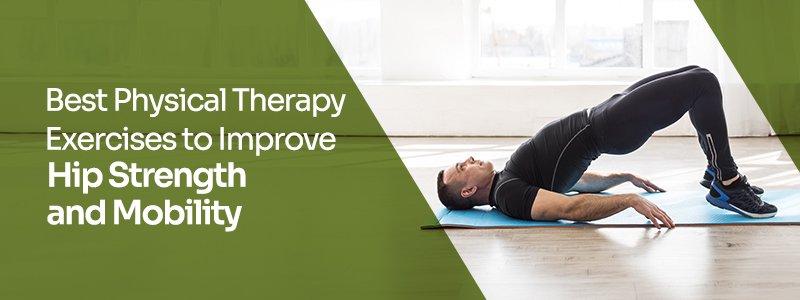
1. Glute Bridges
Glute bridges strengthen the muscles given below while improving stability:
– Gluteal muscles
– Hamstrings
– Core
How to do this exercise:
1) Lie on your back with knees bent,
2) Lift your hips until your body forms a line
3) Then slowly lower yourself.
Advantage of this exercise: This exercise builds the foundation for walking and standing.
2. Clamshell Exercise
Clamshells strengthen the hip abductors.
Note: Hip abductors are the muscles responsible for moving the leg away from the body.
How to do this exercise:
-Performed while lying on your side with knees
Advantage:
– These muscles help stabilize the pelvis during walking.
– Reduces stress on the knees.
3. Standing Hip Abduction
Standing hip abduction improves balance while strengthening the hip muscles.
How to do this exercise:
– Hold onto a surface for support.
– Slowly lift one leg sideways without leaning your torso.
Note: Controlled movement is more important than lifting the leg as high as possible.
Advantage: Strikes balance and strength at the same time.
4. Step-Ups
Step-ups closely mimic movements such as climbing stairs.
How to do this exercise:
– Make a step.
– Place one foot on the platform
– Press through your heel
– Step upward before lowering yourself with control.
Advantage: This develops strength while improving coordination and balance.
5. Hip Flexor Stretch
Tight hip flexors can restrict movement and alter posture.
How to do this exercise:
-Kneel into a lunge position
-Carefully shift your body forward until you feel a comfortable stretch at the front of the hip.
Advantage: Improved flexibility allows the joint to move naturally during daily activities.
Dos and Don’ts for Hip Strength Exercises
For the betterment of hip health, one needs to perform relevant exercises. It matters how you perform them, with careful steps that help you walk the line between achieving results and injury risk. Instead of using physical therapy through mindless repetitions, there needs to be a consistent approach that is thoughtful and effective.
Do’s
- Before one starts exercising, you need to warm up with simple walking or movement that is gentle for a good start during the regimen.
- Every movement must be performed slowly. With proper control.
- In the process of each exercise, one must focus on maintaining correct posture.
- The repetitions, along with resistance, must be increased in a gradual way to improve strength that stays effective for a long time.
- When the body sends its signals, one must act according to that. Hence, if pain develops sharply at any point, one must stop then and there itself.
- Every week one should do exercises in a consistent manner rather than occasionally doing it; that is ultimately ineffective.
Don’ts
- During an exercise, one can ignore pain or swelling occurred during the practice.
- Sacrifice form simply to complete more repetitions.
- One’s progress should not be compared with others’ recovery
- Avoid stretching after exercises involving strength.
- One should continue high-impact activities instantly after returning from an injury rest
- Assume online exercise routines replace evaluation if mobility continues to decline.
Small improvements performed consistently often produce long-term outcomes. While aggressive exercise routines are hard to keep up with, it takes longer time for recovery.
In case of discomfort continuing despite exercise, one should seek professional guidance. It can help identify underlying movement problems before they become more serious. Before this becomes more serious, one should get help for identifying the arising movement issues.
How Saburi Physical Therapy Supports Better Hip Health
Saburi Physical Therapy provides physical therapy services. These services focus on restoring strength, improving mobility and helping patients return to comfortable daily movement.
Rather than relying on a one-size-fits-all approach, therapists evaluate each person’s movement patterns, strength, flexibility and functional goals. Then they create an individualized treatment plan and get into the necessary procedures required.
Through guided exercises, hands-on treatment techniques, mobility training, and ongoing progress monitoring, Saburi Physical Therapy helps patients build stronger hips. It also improves balance, flexibility and overall quality of movement. The result is a more confident path toward long-term hip health and an active mobility-based lifestyle.
Frequently Asked Questions
The most effective approaches combine multiple techniques including balance and fall prevention exercises, gait training, body weight support training, and vestibular rehabilitation. Research shows that programs incorporating task-specific training, progressive difficulty levels, and dual-task activities (combining balance with cognitive tasks) yield the best outcomes for stroke survivors.
Balance-focused physical therapy should begin as soon as medically stable, typically within 24-48 hours after stroke onset. Early intervention is crucial for preventing complications and maximizing recovery potential. However, intensive balance training may begin gradually, starting with bedside exercises and progressing to more challenging activities as the patient’s condition improves.
Most patients begin seeing improvements within 2-4 weeks of consistent therapy, with significant gains typically occurring over 3-6 months. However, recovery timelines vary greatly depending on stroke severity, affected brain areas, overall health, and therapy consistency. Some individuals continue improving for up to two years post-stroke with ongoing rehabilitation.
Yes, home exercises are essential for maintaining and enhancing progress between therapy sessions. Studies show that patients who perform prescribed home exercises 3-5 times per week experience faster improvement and better long-term outcomes. However, exercises should be prescribed by a physical therapist and performed safely, often with family member supervision initially.